Aluminum Tile Trims vs Stainless Steel Tile Trims: A Comprehensive Comparison

In the renovation of kitchens, bathrooms, and commercial premises, tile edge trims serve as indispensable components for safeguarding tile edges, concealing rough cuts, and enhancing the overall aesthetic integrity of the space. Among the most widely adopted metal alternatives are aluminum and stainless steel tile trims. Each material possesses distinct characteristics that cater to diverse project requirements, budget constraints, and environmental conditions. This guide elaborates on their respective advantages, disadvantages, and key differentiators to facilitate informed decision-making for your upcoming tiling project.
1. Cost and Affordability
Price constitutes a primary consideration for both homeowners and contractors, and the discrepancy between aluminum and stainless steel tile trims in this regard is considerable.
Aluminum Tile Trims: They offer significant cost advantages over other metal options. As a lightweight and abundant metal, aluminum entails lower production and transportation costs, which are ultimately passed on to consumers. This renders it an optimal choice for large-scale residential projects or renovations with stringent budget limitations. Even when finished with premium treatments such as anodization or powder coating, aluminum trims remain more economically viable than their stainless steel counterparts.
Stainless Steel Tile Trims: They command a higher initial investment compared to aluminum variants. The alloy’s superior durability, corrosion resistance, and manufacturing complexity—attributed to its inherent hardness—contribute to elevated costs. While stainless steel trims represent a long-term value proposition, the upfront expenditure may be prohibitive for budget-sensitive projects. Nevertheless, the premium pricing is justified in scenarios where longevity and minimal maintenance are non-negotiable requirements for tile edge protection.
2. Durability and Impact Resistance
Durability directly influences the service life of tile edge trims, particularly in high-traffic or high-impact environments where aluminum and stainless steel variants perform differently.
Aluminum Tile Trims: They exhibit sufficient durability for most residential applications but are inferior to stainless steel in terms of structural strength. Weighing approximately one-third of stainless steel, aluminum trims facilitate ease of handling and installation; however, thin-gauge variants (0.019–0.050 inches) are susceptible to dents and scratches from heavy impacts, such as fallen objects or heavy equipment. Thicker aluminum trims or those with reinforced finishes offer enhanced impact resistance but still cannot match the robustness of stainless steel. For wall installations or low-traffic flooring areas, their durability is more than adequate for tile edge protection.
Stainless Steel Tile Trims: Renowned for exceptional structural strength and impact resistance, they outperform aluminum in demanding settings. Stainless steel trims withstand heavy foot traffic, frequent impacts, and harsh operating conditions without denting or warping, making them well-suited for commercial spaces, retail establishments, kitchen flooring, and shower enclosures. Their inherent hardness ensures a long-lasting finish that maintains structural integrity for 8–12 years in commercial settings, solidifying their status as a superior choice in high-demand environments. Once installed, they require minimal maintenance to preserve durability.
3. Corrosion and Moisture Resistance
Both aluminum and stainless steel trims demonstrate corrosion resistance, yet their performance as metal tile edgings varies under extreme environmental conditions.
Aluminum Tile Trims: They naturally form a passive oxide layer that inhibits rust and corrosion, rendering them suitable for moist environments such as bathrooms and kitchens. However, this protective layer is less effective in highly acidic or alkaline settings. Anodized or powder-coated aluminum trims feature enhanced corrosion resistance, but scratches to these finishes may expose the underlying metal, leading to localized corrosion over time. With proper sealing to accommodate thermal expansion, they can also be utilized as outdoor metal edgings.
Stainless Steel Tile Trims: The chromium content delivers superior corrosion resistance compared to aluminum, even in environments with extreme moisture or chemical exposure. They retain their appearance and structural integrity in showers, kitchens—where spills are prevalent—and coastal regions with salt-laden air. Unlike aluminum, stainless steel trims do not require additional surface treatments to resist rust, positioning them as reliable corrosion-resistant options for high-moisture or harsh chemical environments.
4. Aesthetic Appeal and Versatility
Tile edge trims play a pivotal role in interior design, and aluminum and stainless steel variants each offer distinct stylistic advantages tailored to different design objectives.
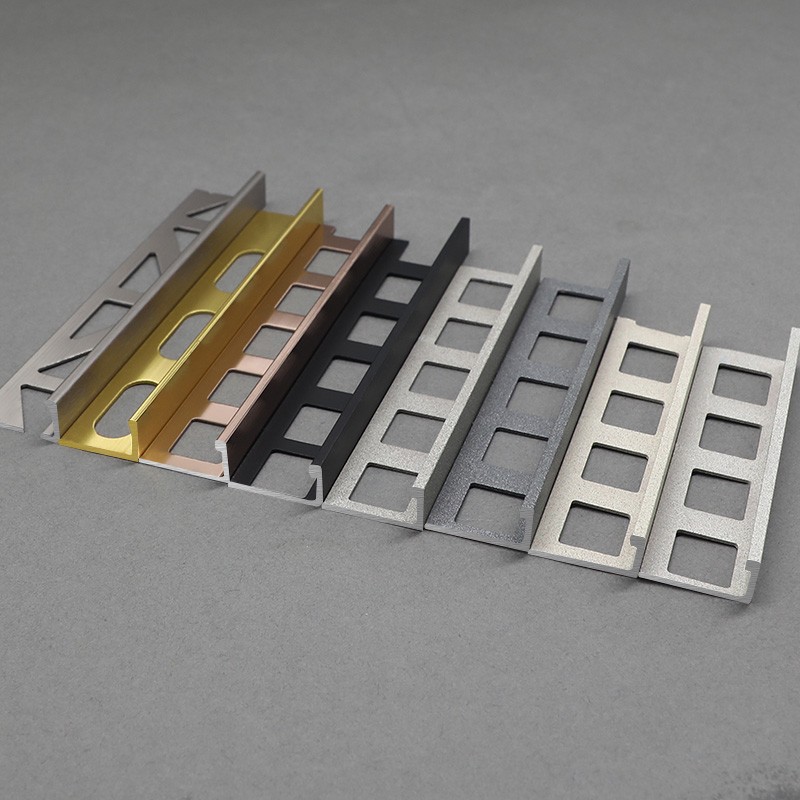
Aluminum Tile Trims: They excel in design versatility among metal edgings. Supporting a wide array of surface finishes, including anodization (matte, brushed, polished), powder coating (custom color options), and heat transfer printing, aluminum trims align with diverse interior styles—from modern minimalism to industrial aesthetics. Available in various profiles (L-shaped, round, square) and customizable to unique specifications, they are a preferred choice for designers seeking flexibility. Their lightweight visual profile complements contemporary spaces without dominating the overall scheme.
Stainless Steel Tile Trims: They impart a sleek, modern, and luxurious aesthetic, distinguishing themselves from aluminum. Popular finishes include brushed, polished, and black titanium, which integrate seamlessly with stainless steel appliances and modern interiors. While offering fewer color variations than aluminum, their metallic luster adds a high-end touch to both commercial and residential spaces. Stainless steel trims maintain consistent appearance and resistance to discoloration, ensuring long-term visual appeal as premium edge solutions.
5. Workability and Installation
The ease of installation differs significantly between aluminum and stainless steel trims, exerting an impact on labor costs and the feasibility of do-it-yourself (DIY) tiling projects.
Aluminum Tile Trims: Lightweight and malleable properties enable easy cutting, shaping, and installation with standard tools—an advantage over stainless steel. Many aluminum trims come with pre-drilled holes, facilitating straightforward installation via adhesive, mortar, or fasteners. End caps are also readily available, eliminating the need for precise 45-degree angle cuts. These characteristics make them ideal for DIY projects or large-scale renovations where efficient edge trim installation is a priority.
Stainless Steel Tile Trims: Inherent hardness renders them more challenging to process than aluminum. Requiring specialized tools (e.g., diamond-tipped cutters) and professional techniques for precise cuts, their increased weight also elevates transportation and installation efforts, often necessitating professional assistance. Despite the labor-intensive process, stainless steel trims deliver a secure, long-lasting finish with minimal post-installation maintenance.
6. Maintenance Requirements
Low maintenance is a key advantage of both metal trims, though their upkeep protocols differ marginally.
Aluminum Tile Trims: Classified as low-maintenance edge solutions, they resist warping, cracking, and dirt accumulation—regular cleaning with a damp cloth and mild detergent suffices. However, scratched finishes may require touch-ups to prevent corrosion, particularly in moist environments. Anodized aluminum trims offer superior wear resistance and demand less frequent maintenance than powder-coated alternatives.
Stainless Steel Tile Trims: Virtually maintenance-free, they outperform aluminum in hassle-free upkeep. Their smooth surface repels dirt and stains, with a quick wipe restoring luster. Unlike aluminum, stainless steel trims do not require scratch touch-ups—though deep scratches may remain visible—and maintain appearance without additional treatments. This makes them ideal for high-traffic commercial spaces or homeowners seeking low-effort edge trims.
Which Should You Choose?
The selection between aluminum and stainless steel trims should be guided by project-specific needs, budgetary considerations, and environmental conditions:
Opt for Aluminum Tile Trims if cost-effectiveness, ease of installation, and design versatility are prioritized, and the application involves residential projects (e.g., bathroom walls, low-traffic flooring) where heavy impacts are unlikely. They are also ideal for projects requiring customizable metal edgings.
Opt for Stainless Steel Tile Trims if superior durability, corrosion resistance, and a high-end aesthetic are required for commercial spaces, high-traffic areas, or moist environments (e.g., showers, kitchen flooring) where long-term performance is critical. They are the top choice for corrosion resistance in harsh conditions.
Both aluminum and stainless steel trims provide excellent edge protection and aesthetic value—your final selection will depend on balancing practical requirements, budget constraints, and design objectives for your tiling project.